Why regional content is becoming OTT’s next big business opportunity

- November 5, 2026
- Ultra Team
India’s OTT opportunity is moving beyond Hindi. As platforms chase deeper engagement and better monetisation, regional content is emerging as a key driver of the next phase of streaming growth
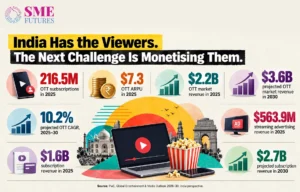
India didn’t lose the streaming war. It won the opening battle decisively with hundreds of millions of viewers brought online, a subscriber base that now stands at 216.5 million. But winning viewers and winning their money, it turns out, are two different wars entirely. Average revenue per user on Indian OTT platforms sits at just $7.3, a number that exposes how shallow that first victory really was.
The market isn’t slowing down because of it rather it’s quite the opposite. It’s projected to grow from $2.2 billion in 2025 to $3.6 billion by 2030, according to PwC’s Global Entertainment & Media Outlook 2026-30. But growth and profitability are no longer the same conversation. Platforms have proven they can pull audiences in; the harder, more expensive problem is making those audiences worth having, while keeping them around, and getting them to pay for the privilege.
Increasingly, the answer being tested across the industry isn’t a bigger Hindi slate or a fresh national platform. It’s the opposite instinct. Going narrower, not wider, deeper into the dozens of language markets that make up India’s actual viewing public. Tamil, Telugu, Marathi, Bengali, Assamese and beyond are no longer being treated as regional afterthoughts to a Hindi-first strategy. They’re emerging as the next real battleground for engagement, loyalty and revenue.
Next phase of OTT growth is regional
Regional storytelling is becoming central to how streaming platforms acquire, engage and retain viewers. The PwC report further identifies local-language content as one of the key growth engines for India’s OTT market, particularly as platforms look beyond Hindi-speaking audiences.
Mautik Tolia, MD and CEO of Bodhi Tree Multimedia, believes the first wave of Hindi-first OTT expansion is giving way to a deeper regional strategy.
“The pan-India, Hindi-first model captured the first wave of OTT growth, but that audience is largely saturated now. The next phase of growth depends on going deeper into regional markets rather than producing more content within the same language and cultural framework.”
“Instead of one large Hindi slate aimed at a national audience, the more effective strategy is building strong, culturally specific content within individual language markets, and then allowing the strongest stories to travel outward from there, rather than starting with a homogenised, pan-India brief,” Tolia further adds.
“Creators and short-form video platforms form the primary discovery engine for regional content. India’s SFV audience stands at over 300 million users, with more than half of their time spent focused on regional language content. A local creator can establish cultural trust and scale an audience around a regional trend far faster than traditional media ecosystems,” says Sumit Gupta Founder & CEO, Viral Pitch.
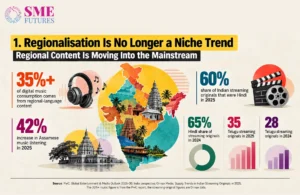
The shift is already visible in the supply of streaming originals. Ormax Media found that Hindi accounted for 60% of Indian streaming originals in 2025, down from 65% in 2024, while Telugu originals increased from 28 to 35. Platforms are also expanding their commissioning plans across more Indian languages.
“A platform can decide on a Monday morning to commission in Bhojpuri or Assamese. What it cannot do is conjure the people who know how to light, shoot, cut and grade in that market. Those people exist now, and almost none of them were trained by the industry. They trained themselves, on equipment they bought with their own money, making things nobody had commissioned,” points out Archisman Misra, Founder & CEO, StudioBackdrops.com.
The opportunity, therefore, is not simply to add more content. It is to reach audiences that have historically been less deeply served by national platforms.
Regional no longer means restricted to one market
The bigger change is that digital distribution has weakened the geographic boundaries around regional content.
A regional film or series can now be subtitled, dubbed and distributed across multiple states, platforms and even international markets. That is changing how the content itself is valued.
Anahita Mukherjee, Counsel at Ascendus Law Partners, has nearly a decade of experience in content licensing, distribution and syndication across leading media companies. She says platforms are increasingly treating regional titles as a portfolio of rights rather than a single digital licence.
“Indeed, they are. From a rights perspective, the shift is that regional content is no longer necessarily being viewed only by its original-language audience. A regional title with demonstrated audience traction can have significant value beyond its primary market, particularly where it can be dubbed, subtitled or adapted for consumption across languages and territories.”
“Rather than treating “digital rights” as a single grant, parties are increasingly looking at language, territory, platform, exploitation window and monetisation model as distinct commercial variables.” she adds.
That expanding view of regional content is also changing how the industry values the underlying IP, says Anand Saga, Lead – Creative & Business at ProducerBazaar.
“The biggest change is that content is increasingly being treated as an IP and rights portfolio, rather than simply a programme or film meant for one market.”
“Earlier, a regional film was often valued primarily on its theatrical performance, satellite potential and strength in its home territory. Today, the conversation includes OTT, digital, dubbing, subtitling, international syndication, language rights and other downstream opportunities,” he adds.
The same pattern is visible beyond OTT. Regional cinema is increasingly travelling nationally through dubbed and subtitled releases, while regional-language music is also becoming a larger part of digital consumption.
The influence of regional filmmaking is also extending to the global stage. Marathi film Gondhal, rooted in Maharashtra’s traditional Gondhal ritual, was selected as India’s official entry for the 99th Academy Awards, putting a distinctly regional story and cultural tradition in the international spotlight.
That creates a much larger commercial universe around a successful regional title. Its value can extend beyond the original release through language rights, overseas distribution, multiple digital windows and future adaptations.
From acquiring viewers to keeping them
The most important shift may be happening after the viewer arrives.
As subscriber acquisition becomes more difficult, regional programming is increasingly being judged by its ability to build repeat consumption and reduce churn.
“It is not one single metric. Regional content can contribute across the entire consumer journey, from acquisition and engagement to retention and differentiation. The biggest advantage is that strong regional content can create a more meaningful connection with a specific audience, which is difficult to replicate through a broad, one-size-fits-all content strategy. There is also a significant opportunity in catalogue content,” says Rajat Agrawal, COO of Ultra Media and Entertainment.
That distinction is becoming critical in a market where simply adding subscribers is no longer enough. The broader industry is shifting towards improving engagement, retention and revenue per user, with regional programming becoming one of the tools platforms can use to deepen those relationships.
For producers, however, audience growth is only part of the equation. A strong regional title can lose future value if too many rights are locked into a single deal.
“Regional content has the value to generate revenue across multiple languages, territories, platforms and exploitation models. Producers need to ensure that a single OTT transaction does not unnecessarily obstruct these future opportunities through broad grants or long-term exclusivity,” says Mukherjee.
The structure of the deal can ultimately determine how much value a producer can extract from the same IP over time.
Advertising could unlock next layer of value
Subscription revenue will remain important, but India’s price-sensitive market means advertising is likely to play a larger role in OTT economics. Advertising-supported streaming are set to become an increasingly important revenue source as platforms look to monetise audiences beyond paying subscribers.
Regional content fits naturally into that model because it can give advertisers access to specific language, geographic and cultural audiences.
Yasin Hamidani, Director, Media Care Brand Solutions, says advertisers are already moving beyond a metro-first approach.
“Regional content is pushing brands to look beyond a metro-first media strategy. As digital video consumption grows across Tier-2 and Tier-3 markets, advertisers are increasingly allocating budgets by language, state and cultural context rather than using one national campaign everywhere. India’s OTT audience has reached nearly 665 million in 2026, which shows the scale now available beyond traditional urban audiences. For brands, regional media is becoming a core growth channel rather than an extension of the national plan.”
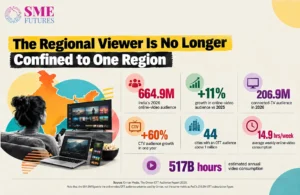
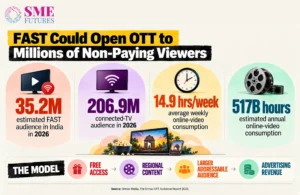
The audience base continues to expand. Ormax Media estimates India’s digital-video audience at 664.9 million in 2026, up 11% from 2025, while the connected-TV audience has jumped 60% to 206.9 million.
The combination of scale and sharper targeting could make regional inventory increasingly valuable to both national brands seeking deeper penetration and local businesses looking to reach specific markets.
There is also a larger question around viewers who consume large amounts of online video but are reluctant to pay for multiple streaming subscriptions. FAST, or Free Ad-Supported Streaming TV, offers a different model. Instead of charging viewers a subscription fee, platforms provide free content through curated, always-on channels and monetise that audience through advertising.
For regional content, this creates another route to reach viewers who may be difficult to capture through subscription-led OTT alone.
“India has demonstrated an enormous appetite for video consumption, but willingness to pay for multiple OTT subscriptions remains much more limited. There is, therefore, a fundamental difference between video consumption and subscription monetisation,” says Manish Sinha, Founder and CEO of RunnTV.
The model could be particularly relevant as connected-TV adoption expands. The 2026 audience data shows the CTV universe at 206.9 million, up sharply in just one year.
“The ad-supported model addresses that gap by allowing platforms and content owners to monetise audiences without requiring every viewer to become a paying subscriber. When you combine that with regional content, the opportunity becomes even stronger because you are potentially bringing high-engagement audiences into a monetisable ecosystem that may otherwise be underserved by subscription-led platforms,” says Sinha.
For regional content owners, that potentially changes the size of the addressable market: a library created for one language audience can be packaged into channels and distributed across states, devices and platforms.
Real opportunity is “pan-India while thinking regional”
The regionalisation of OTT does not necessarily mean the end of national platforms. Instead, the next successful model could be platforms that operate nationally but develop much deeper language-specific strategies.
“I don’t see the future as either pan-India or regional. I think the next phase of OTT will be about being pan-India while thinking deeply regional. Audiences may belong to one language market, but their content consumption is increasingly multilingual,” says Agrawal.
That may be the defining shift in India’s next OTT cycle.
The opportunity is no longer simply to produce more Hindi programming or add more subscribers. It is to understand India as a collection of distinct, multilingual audiences and build content businesses around those differences.
Regional content can acquire the viewer. Strong local storytelling can keep that viewer engaged. Dubbing and subtitling can take the story beyond its original market. Advertising and FAST can widen the monetisation pool. And successful titles can evolve into IP with a life well beyond their first release.
The OTT opportunity, in other words, is becoming less about one India-sized audience and more about unlocking the commercial value of many different Indias.