How India’s Toy Market Is Evolving with D2C, Retail and IP

- July 17, 2026
- Ultra Team
From the time of the Indus Valley Civilisation, when children played with simple clay toys and figurines, to today’s world of smart and tech-enabled toys, India’s toy industry has changed a lot. What started as handmade traditional toys has now become a fast-growing and organised market.
However, things have started changing. As per IBEF’s report “India’s Growing Toy Exports”, exports increased by more than 140 percent between FY17 and FY22, while imports fell by 30 to 40 percent. This shows that India is slowly becoming more self-reliant. The market is also growing steadily. IBEF’s “The Toy Story in India” report says the industry is expected to grow at around 12 percent every year between 2022 and 2028, while earlier estimates showed a growth rate of 13.3 percent between 2019 and 2024.
Today, the industry includes many categories such as traditional toys, educational and STEM toys, soft toys, action figures, ride-on toys, and digital or tech-based toys. The way toys are sold is also changing. Apart from retail outlets, companies are using online channels as well as D2C marketing strategy.
Overall, the industry is moving away from relying solely on foreign brands and licensing towards local manufacturing and sales through various other means, including partnerships, with India becoming one of the fast-growing toy markets.
Offline retail is still ruling the toy industry, especially in a country such as India, where even offline discovery plays an important part. Companies are concentrating more on spreading themselves out across cities in order to reach larger audiences.
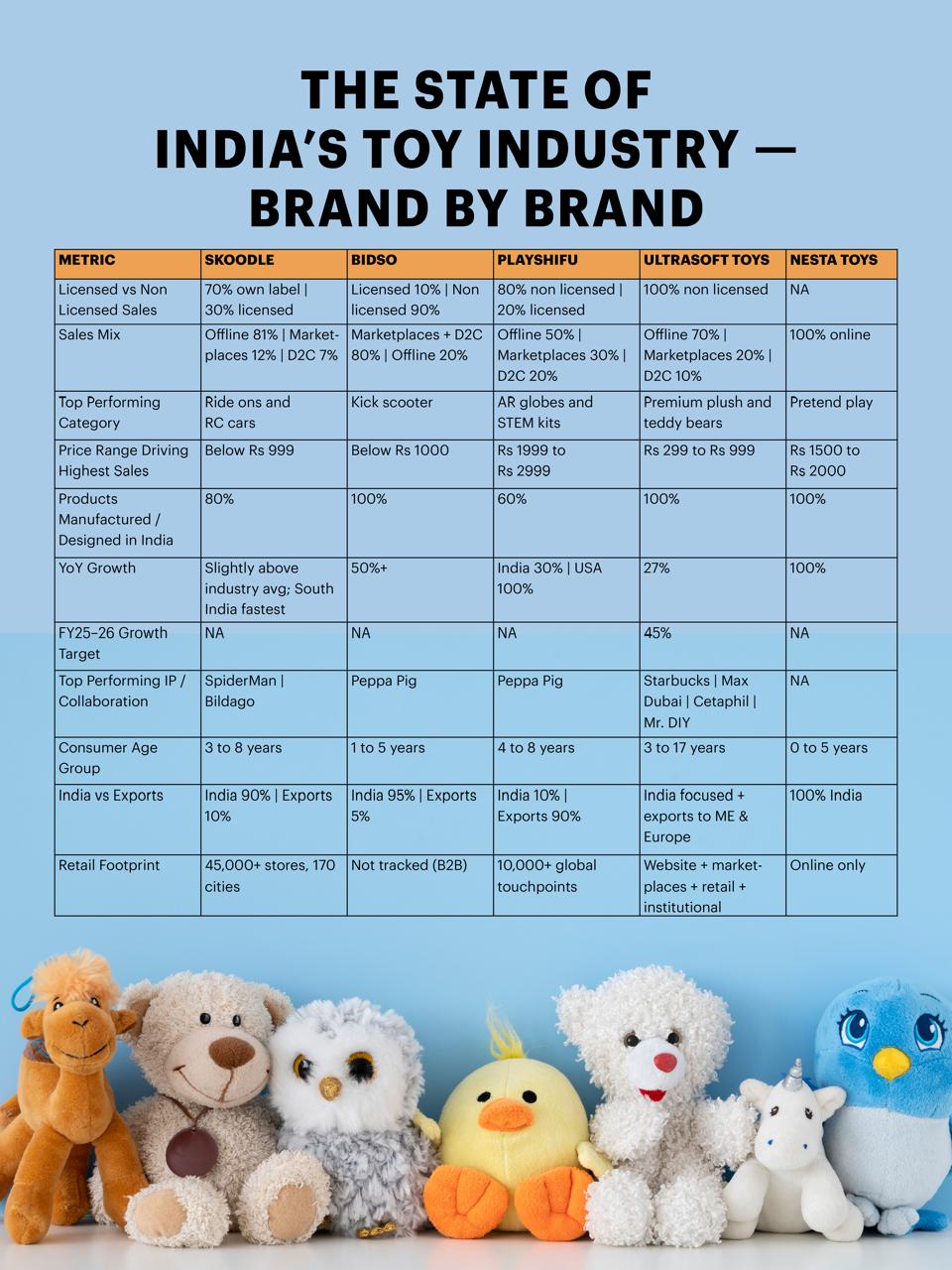
With over 45,000 retail touchpoints across 170 cities, Skoodle reflects how scale is still largely driven by physical distribution. At the same time, modern trade and large format stores are helping brands build visibility and trust.
Sushilkumar Agrawal, CEO, Ultra Media and Entertainment Group, said, “At Ultra Soft Toys, we follow an omnichannel approach. While offline retail remains our core strength, we are steadily expanding across marketplaces and D2C to reach consumers directly and build stronger brand visibility.”
While retail brings scale, D2C channels are emerging as an important long term play. Brands are investing in their own platforms to engage directly with parents and children.
“D2C is still small for us today, but it is the space we are investing in the most. Marketplaces and offline give us scale, while D2C gives us a direct relationship with parents,” said Shah.
PlayShifu also follows a similar approach. Dinesh Advani, Co-founder, PlayShifu, shared, “Marketplaces help us reach new customers, while our D2C channels help us build a loyal and engaged base that keeps coming back.”
Neha Makdey, Founder and CEO, Nesta Toys, said, “Our growth is currently driven through our D2C website, marketplaces and quick commerce platforms, allowing us to reach parents wherever they prefer to shop while maintaining a consistent brand experience.”
This shift shows that while D2C may not yet be the largest channel, it is becoming critical for brand building and repeat engagement.
Local Manufacturing Gains Ground
Government initiatives and BIS compliance have pushed companies to focus on local manufacturing. This has reduced dependence on imports and improved product quality.
Aditya Krishnakumar, Co-founder, BIDSO, noted, “BIS compliance has shifted the industry from price led sourcing to quality led manufacturing. It has encouraged better designs and stronger systems.”
BIDSO manufactures 100 percent of its toys in India and has seen over 50 percent year on year growth. This reflects a larger trend where companies are investing in local supply chains to gain better control over cost, speed, and innovation.
“Local supply chains enable rapid prototyping and reduce lead times, helping us move faster from idea to product,” highlighted Advani.
Agrawal added, “The focus on local manufacturing and BIS compliance has strengthened our product development process. It has encouraged us to source more locally, improve quality standards, and design products that meet both regulatory requirements and customer expectations.”
Makdey also highlighted, “We are building a proudly Indian brand with products that are designed in house and manufactured locally, combining global design standards with Indian craftsmanship.”
IP and Content Take Center Stage
The toy industry is no longer just about products. Content, storytelling, and intellectual property are becoming key drivers of growth and differentiation.
Skoodle is investing in building its own identity. “We are focusing on our own IP and original content rather than relying only on licensed characters. We want the brand itself to be recognisable,” mentioned Shah.
At the same time, licensed products still play a role. Skoodle sees 30 percent of its sales coming from licensed characters, while BIDSO reports around 10 percent from licensed toys.
Agrawal said, “Licensed characters help us connect with established fan bases, while our original designs and custom creations allow us to offer unique products tailored to our customers’ needs.”
Makdey emphasised, “Our focus remains on building original intellectual property, with every product conceptualised and designed in house to maintain quality and innovation.”
Investors also see strong potential in this space. Abhiram Bhalerao, Partner, V3 Ventures (Verlinvest), said, “We are seeing real opportunity in India first brands that combine content, community, and retail distribution. The focus now is on building strong and defensible IP.”
STEM and Learning Lead Growth
Educational and STEM toys are becoming one of the fastest growing segments, driven by parents looking for value beyond entertainment.
PlayShifu has built its portfolio around interactive learning. “By creating innovative products with little direct competition, we are able to stand out and command a premium,” stated Advani.
Similarly, Skoodle is positioning its products around learning and development. From preschool toys to construction play, the focus is on building skills such as creativity, motor development, and problem solving.
Agrawal noted, “We are expanding our range of educational and interactive soft toys that combine fun with learning, while focusing on value engineering to keep products affordable.”
Makdey added, “Montessori and early learning principles are at the heart of every product we create, focusing on screen free, hands on play that supports cognitive and motor development.”
This trend is also reflected in pricing. While a large share of sales still comes from products under Rs 1000, premium segments are growing steadily, especially in educational categories.
Exports and Global Ambitions
India is also emerging as an export hub for toys, with several brands expanding globally.
PlayShifu exports to more than 30 countries, with exports contributing nearly 90 percent of its business. “India is central to our operations and a true global hub for us,” said Advani.
At the same time, domestic demand remains strong. Most brands still derive the majority of their revenue from India, but exports are becoming an important growth lever.
The Road Ahead
The Indian toy industry is at an interesting stage of evolution. It is moving from a fragmented and import dependent market to a more organised, innovation driven ecosystem.
However, challenges remain. Distribution complexity, seasonality, and compliance requirements continue to impact growth.
Bhalerao sums it up well: “The ecosystem is scalable but still maturing. Real growth will come from solving distribution, compliance, and building strong brands.”
As companies invest in manufacturing, IP, and new channels, the industry is expected to see consolidation and stronger Indian brands in the coming years.
The shift is clear. From clay toys to connected play, India’s toy story is now being shaped by innovation, localisation, and a deeper understanding of the modern consumer.